WHICH IS MORE IMPORTANT GREAT TEAMS OR GREAT LEADERSHIP?
I had an opportune moment to catch-up with a multi-award winning CEO the other day and we chatted about leadership, teams and change. I won't name them (they may not agree with my article) but I am happy for them to post comments or feedback on my reflections from the conversation.
I long time ago I lost an argument and learned something valuable. I was advocating the importance of good teachers and great teaching. My interlocutor, married to a teacher, disagreed and asked me: "When you had a problem or was unsure of something, who did you ask first?". I then immediately understood the value of peer-groups and the power of culture and belonging.
Teachers and Leaders are important, but in most cases it is your friends, family, colleagues, community and culture that shape your values, beliefs and behaviours rather than the leader. Nonetheless awards and accolades are always for Leadership and courses, programmes, and pithy aphorisms are inevitably about celebrated leadership.
My CEO friend is no shrinking violet. They are bold, with strong conviction, direct style and unequivocal: Exactly the type who so long as their business is successful will win awards. Moreover their vision and drive has no-doubt contributed to the business success. So I was surprised when they modestly said that culture is not about the leadership but about the team.
We touched on covid and lock-down and the impact that this has had on people, motivation and a sense of belonging and community that is ostensibly compromised at best or lost entirely when people are isolated from their working community. There is no serendipity, banter or indeed innovation when every action is deliberate phone, ms-teams or zoom call for a specified purpose.
This is of course off-set by those who do create channels and opportunities to look out for each-other, colleagues, welfare and maintain their engagement with then team, organisation and purpose. But even this is a deliberate action lacking the informality and spontaneity that the past hallmark of collaborative culture.
My CEO friend made the good and logical point that cohesive teams can perform outstandingly well in very difficult circumstances because of their bonds with each-other rather than any form of allegiance to the leader. This is well observed, and it is a great leader who understands and takes action to create the environment where this can happen.
If you are interested in projects, change, culture or coaching email me tim@adaptconsultingcompany.com I am happy to have a coffee and a conversation to share ideas on what might be helpful to your people, teams, projects and organisation.
Tim Rogers
MBA (Management Consultancy) & Change Practitioner
ICF Trained Coach IoD Business Mentor
https://www.adaptconsultingcompany.com/coaching-and-mentoring/

Tuesday, 23 March 2021
WHICH IS MORE IMPORTANT GREAT TEAMS OR GREAT LEADERSHIP?

Wednesday, 10 March 2021
SOME IDEAS AND LESSONS FROM COMMISSIONING BIG PROJECTS AND DELIVERY PARTNERS
SOME IDEAS AND LESSONS FROM COMMISSIONING BIG PROJECTS AND DELIVERY PARTNERS
The Government has conceded that it significantly underestimated the cost and scope of its largest ever IT project when it was launched last year - with the total now around £35m over the original budget.
Source:
https://www.bailiwickexpress.com/jsy/news/cost-major-government-it-project-more-doubles/#.YEikHObLcYJ
The Integrated Technology Solution (ITS) Programme will implement an integrated solution that will replace the current Finance, Procurement and Commercial, People Services and Payroll systems. The Integrated Technology Solution programme is a critical foundation for the wider modernisation. Crucially, it enables cross-department collaboration benefits and efficiencies and acts as a backbone and core enabler for the other elements of government transformation.The new solution can capture 15 years of advancement – transforming the way staff and customers interact – including greater self-service, mobile working and automation of routine tasks.
Key objectives include:
✓ Supports modernisation of Government
✓ Cloud hosted and supported for future proofing
✓ Easy and intuitive to use
✓ No customisations
✓ Mobile enabled
✓ Scalable for the future
✓ Greater accessibility of GoJ services by citizens and businesses.
New, simplified and standard ways of working are essential. The changes cover the following areas:
✓ Attract, recruit and onboard talent
✓ Improve how we procure goods and services
✓ Improve how we manage our relationships with suppliers
✓ Streamline how we make and receive payments
✓ Understand our data and make informed decisions
✓ Provide greater self-service opportunities.
I note that the Comptroller and Auditor General (C&AG) has said...Another key focus [ for the C&AG] in 2020 is the commencement of the programme for an Integrated Technology Solution (ITS) for finance, payroll, human resources and procurement systems.
Source:
https://www.jerseyauditoffice.je/wp-content/uploads/2020/05/Project-Specification-ICT-Could-Implementation-22-May-2020.pdf
I would be interested to see the outcome of the C&AG Review and the findings of the Public Accounts Committee. What can we learn from e-Gov and ITS and how confident can we be if it is £35m over the original ostensibly before the project has really got started. Here are some tips I have picked up from various sites
1 Articulated Business Vision
The organisation has clearly articulated specific business objectives it will achieve once the solution has been implemented.2 An Intelligent Client
An ICF team that demonstrates strategic, commercial and partnership behaviours an Intelligent Supplier expects.3 An Intelligent Supplier
A supplier that understands the ‘holistic’ objectives of an Intelligent Client and strategically supports them.4 Clear Service Delivery Requirements
Clear articulation of the ‘use cases’ and business objectives the client is seeking from the supplier and its solution to enable for it.5 Supplier Expert Responsibilities
Clarity of an Expert Supplier’s “Duty to Warn” and how that impacts the pre-contractual due diligence responsibilities between the client and the supplier.6 Fit-For-Purpose Contract
Contract terms that are reverse engineered from the business objectives, to support ‘enabling’ behaviours.7 Buying Governance
Procurement governance that drives the right foundations to assure a fit- for-purpose solution/supplier is procured.8 Relationship Management
Strategic Relationship Management that assures on-going benefits are realised for the life cycle of the relationship.Saturday, 20 February 2021
REORG: HOW TO GET IT RIGHT
- 70% of reorgs deliver some value, but only 16% deliver the results they were supposed to in the time they were supposed to. The main reasons are: employees resisting or leaving, insufficient resources, distraction from day-to-day work, leaders resisting, or the org chart changes but the way people work stays the same.
- In most reorgs, only 20-30% of the organisation changes. The knack is identifying which bit – usually to be found where what leaders think is broken intersects with what really matters in the business.
- Communication of reorgs usually fails due to ivory-tower idealism (over enthusiastic leader thinking all will be well) or wait and see (keeping everything secret).
- If the reorg team cost and likely business disruption exceeds the anticipated cost reduction or revenue increase, the reorg should not go ahead.
- The timeline should be reverse engineered from the implementation date, and include two or three immovable deadlines.
- Construct the Reorg's Profit and Loss. Work out what is to be achieved and how to measure successful completion. Is a reorg necessary to meet these targets. If so, accelerate the process in order to minimize upset and deliver the business results needed as soon as possible.
- Understand the business's current weaknesses and strengths. Don't do things just for the sake of it and communicate often, both in order to share information and to listen.
- Develop a new structure that is tailored to the company's needs, taking advantage of the wisdom within the organization and engaging key stakeholders. Many reorganizers jump straight to this step, say the authors. Doing so is "a fatal error".
- Design and plan implementation. This should involve setting immovable deadlines and assessing leadership in order to ensure the right people are in the right roles
- Launch, learn and course-correct. Ensure that the reorg is delivering the expected results. When things return to "normal" are targets being met?
Thursday, 4 February 2021
WHY PROJECTS FAIL, DIAGNOSIS & HOW TO SUCCEED
WHY PROJECTS FAIL
#1 – Scope Creep
Scope is everything that you are going to do and conversely, not going to do. So once you’ve figured out exactly what the project work is, usually via a Work Breakdown Structure, you need to freeze it and zealously guard against unplanned changes to it. So planned changes via a change control board are ok, since then the PM can issue a new schedule, risk and budget plan as needed. Otherwise, you will surely miss your target and make both the management and customer unhappy.
#2 – Overallocated Resources
Often there are too few resources working on too many projects at the same time. In conjunction with that, managers don’t seem to have a grip on what their resources are doing all the time. Team members are left to figure out for themselves what projects they should be working on and when. Better is for managers to meet weekly to discuss resource usage perhaps using a spreadsheet to track.
#3 – Poor Communications
Many people on a project will know the project manager only through his or her communications. And they will know them by how their voice comes across over the phone or especially by how well-written their emails are. If the project manager is not a clear unambiguous communicator, chaos and confusion will ensue.
#4 –Bad Stakeholder Management
Stakeholders have a vested interest in the project for the good or sometimes to the detriment of the project. It is the project manager’s job not only to identify all stakeholders, but know how to manage and communicate with them in a timely fashion. A communication management plan helps here.
#5 – Unreliable Estimates
Estimates are very often just guesstimates by team members who are trying to calculate duration of tasks based on how long it took them last time. This may turn out to be totally accurate or may be completely wrong. And if wrong, leads to a flawed schedule and increased risk. Historical records kept between projects helps solve this.
#6 – No Risk Management
Every project is unique and hence, has uncertainty. When we try to qualify and quantify that uncertainty, we call it risk. It is incumbent upon the project manager to proactively anticipate things that might go wrong. Once he has identified risks, then he and the team can decide on how to respond to (e.g., mitigate, avoid) those specific risks should they occur.
#7 – Unsupported Project Culture
I was once asked to consult for a company and discovered that a complex project was being handled by an untrained secretary using 20 Excel spreadsheets. In this case, management clearly did not fully understand what it took to manage a project either in tools or using trained personnel. This is not easily solvable because it requires education of management and a cultural shift.
#8 – The Accidental Project Manager
This is similar to but not exactly the same as the unsupported project culture. In this instance, what typically happens is that a technical person (software developer, chemist, etc.) succeeds at the job. Based on that, gets promoted to project manager and is asked to manage the types of projects they just came from. The problem is they often don’t get training in project management and may well lack the social skills the job calls for. And so they flounder and often fail despite previous successes.
#9 – Lack of Team Planning Sessions
There is no more effective way to kick off a meeting than to have the entire team come together for a planning session. This enables everyone to not only work together on project artifacts (schedule, WBS) but also to bond as a team and buy into the project.
#10 – Monitoring and Controlling
Many project managers will create a schedule and never (or rarely) update it. Or if they do, they’ll just fill in percent done, which is an arbitrary number often picked out of the air by the team member. Better if they record actuals such as date started, work accomplished and estimate of remaining work.
DIAGNOSIS: SEVEN PROJECT PERFORMANCE FACTORS
Does the focus on business value, or technical detail?
This involves establishing a clear link between the project and the organizations key strategic practices. The project plan needs to cover the planned delivery, the business change required and the means of benefits realization.
Case Study: I have seen projects fail were time is spent myopically on the detail of an issue, often a supplier contract issue, and not the overall purpose eg to produce an ROI of 8% in 3 years. In some cases we would be wise to pivot, take a new approach, rather than get bogged down. The effect of not doing so is to delay delivery of a function or feature with a disproportional consequential impact on the people and overall programme. Projects seldom operate in isolation and problems in one inevitably impact upon others and/or business as usual.
Is there clear accountability for measured results?
There must be clear view of the inter-dependencies between the projects, the benefits, and the criteria against which success will be judged. It is necessary to establish a reasonably stable requirement baseline before any other work goes forward. Requirements may still continue to creep. In virtually all projects there will be some degree of “learning what the requirements really are” while building the project product.
Case Study: I have experienced situations where incentives, rewards, and punishments tear people apart by pulling in different directions. Typically the tug between projects and business as usual means compromises for both, or outright failure of one because of another. There needs to be a relentless review of: What is it we are trying to achieve here? And a clear focus on output or outcome measures on the agreed dials: Does this move the needle in the right direction?. If we simply congratulate ourselves on effort and not outcome we risk the trials of Sisyphus and burnout [Sisyphus -was punished by being forced to roll an immense boulder up a hill only for it to roll down every time.]
Is there a consistent processes for managing unambiguous checkpoints?
Successful large projects typically have software measurement programs for capturing productivity and quality historical data that can be sued to compare it against similar projects in order to judge the validity of schedules, costs, quality, and other project related factors. The lack of effective quality centered mechanisms can be a major contributor to both cost and schedule overruns.
Case Study: I have seen suppliers argue that there is no problem with being 20 days late with Phase A because Workstream B is 20 days ahead of schedule. This is misdirection. Generally of a project is late it will only get later! If your track record is 20% late then the probability of recovering that time is low unless there is a clear understanding of cause and an intervention of consequence. My own experience is that projects seldom improve productivity and instead cut scope or quality to recover lateness. In one example comprehensive testing was compromised to random sample testing in order to gain pace, but inevitably the hope-value (that everything will be ok) did not pay-off. These compromises generally creates further problems later with consequential impact on cost.
Is there a consistent methodology for planning and executing projects?
There should be a detailed plan developed before any release date of a project is announced. Inadequate planning is one of the major reasons why projects spin out of control.
Case Study: I am a fan of both waterfall and agile projects and both PRINCE2 and scrum have their benefits. For well understood projects, processes or services which are repeated with precision the waterfall approach is appropriate and time spent on designing the ginger-bread cutter [process and plans] is worthwhile when churning out products and services that conform exactly to a well prepared plan. However many are low volume, unique or ambiguous and in these contexts agile / scrum may be better, evolving, innovating, developing and improving as things progress. There is real merit in both but I have seen success and failure in mixing the two into Waterfall: Thinking and planning before doing is good. Scrum: Leaning, developing and innovating is good. waterfall + scrum = scrummerfall. Some scrummerfall approaches are like a series of small waterfall projects linked together, ostensibly as phases or stages of a later mission. However problems occur when you are managing plans, budget, delivery to a waterfall (PRINCE2) standard [like a bus on a route], but the activity is agile (scrum) [like an explorer on a bike].
Do you include customer at the beginning of the project and continually involve the customer as things change ?
It has been observed that successful projects occur when end users (customers) and the project members work as teams in the same cubicle, although this is not always possible. Projects are less likely to fail if there are informed customers giving meaningful input during every phase of requirements elicitation, product description and implementation. The customer needs to be asking, “how are the project result used over time and what do I get out of the results?
Case Study: I have seen projects lead by the IT department either because the customer has abrogated their responsibility or because the IT department feels that they have a better understanding of the customer needs, wants and expectations than the customer. A doctor will consult a patient before, during and after prescription. They may be expert, but neither the physician or patient will think it wise to proceed without some mutual understanding and consensus. Inevitably the communication gap brings frustration and can lead to "failure", whether real or perceived, the problem being that each may have a different criteria for success or failure.
Do you motivate people so that project efforts will experience a zone of optimal performance throughout its life?
This involves managing and retaining the most highly skilled and productive people. Knowledge is money. A project team made up of higher paid people with the right specialized skills is worth more per dollar than a group of lower cost people who need weeks or months of training before they can start to be productive.
Case Study: I have always believed that projects should be delivered on-time, on-budget, to-specification, but also develop the participants to be competent, capable, with drive and desire. So creating, nurturing and supporting the team is often as important (and frequently more important) than one project. Because a competent, capable, team with drive and desire can do so much more than one project! There can be problems however if the team is regarded as a component, like paint rather than an artist. When people are dropped in or pulled out they become ingredients and their collective skills, expertise and experience is wasted. I have seen projects that simply swap people in or out based on availability rather than their value to the team.
Do you provide the project team members the tools and techniques the need to produce consistently successful projects?
The project team must be skilled and experienced with clear defined roles and responsibilities. If not, there must be access to expertise which can benefit those fulfilling the requisite roles.
Case Study: I have seen organisations spend millions on supplier agreements and then scrimp on the training and development of the teams who will deliver a project. That's like buying a Formula 1 car and than expecting a bunch of people to manage, maintain and drive that car without the training and development that is necessary. They then wonder why their Formula 1 investment is not achieving Grand Prix performance.
ELBEIK AND THOMAS’S SUCCESSFUL PROJECT REQUIREMENTS
By speaking to experienced project managers Sam Elbeik and Mark Thomas attempted to identify the critical factors that must be addressed if a project is to be completed successfully. They developed a six stage process for managing projects namely: define, plan, build the team, lead and motivate, control communications, review.
Key success factors in rank order
- Clearly defined objectives
- Good planning and control methods
- Good quality of project managers
- Good management support
- Enough time and resources
- Commitment by all
- High user involvement
- Good communication
- Good project organisation and structure
- Being able to stop a project
Tim HJ Rogers MBA CITP
PROJECTS, PROGRAMMES and CHANGE /  CONSULTANT MENTOR COACH
Adapt Consulting Company
Consult CoCreate Deliver
Mob +447797762051 Tim@AdaptConsultingCompany.com

Tim Rogers is an experienced Project and Change Leader. He is founder of ciChange.org and curator for TEDxStHelier.Com . Roles have included Programme Manager for the incorporation of Ports and Jersey, and Jersey Post, as well as Operations Change and Sales Support for RBSI/NatWest. He is also Commonwealth Triathlete and World Championships Rower. He has a passion for learning and has been a Tutor/Mentor for the Chartered Management Institute. He is a Chartered Member of the British Computer Society, has an MBA (Management Consultancy) and is both a PRINCE2 and Change Management Practitioner.
FIVE DYSFUNCTIONS OF A TEAM
While the Five Dysfunctions of a Team is an interesting story, the popularity of the book is due to the simple and accessible model of teamwork that it introduces.
#1 Absence of Trust
Bottom of the pyramid is the absence of trust, when team members are unable to show their weakness, resulting in being reluctant to be vulnerable and being open with one another. Team members will be afraid of admitting their mistakes and will be unwilling to ask for help.
#2 Fear of Conflict
Lack of trust results in fear of conflict which in turn results in team members incapable of engaging in debates or openly voicing their opinions. The team completely avoids conflicts which results in inferior results.
#3 Lack of Commitment
Fear of conflict results in lack of commitment. As team members have not bought into the decisions, they don’t feel committed to the same which resulting in an environment where ambiguity prevails.
#4 Avoidance of Accountability
Lack of commitment results in team members not making each other accountable. If one has not bought into the decision, they won’t make their peers too accountable.
#5 Inattention to Results
If the team members don’t feel accountable, they put their own needs [ego, recognition, career development etc.] ahead of the team goals. This results in team loosing sight and the company suffers.
If you want to explore your thoughts, ideas and direction perhaps think about receiving coaching or mentoring. I would be happy to chat about Coaching or explain the IoD Mentor Programme and what might work best for you (or your organisation) - no charge.
Tim HJ Rogers MBA
CONSULTANT MENTOR COACH
MBA (Management Consultancy) & Change Practitioner
ICF Trained Coach IoD Business Mentor
Mob 447797762051
Tim@AdaptConsultingCompany.com
References
https://en.wikipedia.org/wiki/The_Five_Dysfunctions_of_a_Team
https://internalchange.com/5-dysfunctions-of-a-team-summary/
https://medium.com/@leenasn/book-summary-the-five-dysfunctions-of-a-team-f3299a1f1a3c
Tuesday, 2 February 2021
USEFUL TOOLS TO STRUCTURE YOUR BUSINESS, YOUR LIFE OR YOUR THINKING
USEFUL TOOLS TO STRUCTURE YOUR BUSINESS, YOUR LIFE OR YOUR THINKING I have often found that some tools, if used loosely and flexibly can be valuable as a trigger for conversation, reflection and action. I say loosely because life should not be formulaic, but should be explored. Models should not restrict thinking but reveal possibilities, and it is the exploration of these that can bring opportunity and growth. In this article I will journey from business mission and vision to personal fulfilment travelling through the some useful models that may help us understand the components and formulate strategies to improve the process and outcome for either, and ideally both Read more https://adaptcoaching.blogspot.com/2021/02/useful-tools-to-structure-your-business.html If you want to explore your thoughts, ideas and direction perhaps think about receiving coaching or mentoring. I would be happy to chat about Coaching or explain the IoD Mentor Programme and what might work best for you (or your organisation) - no charge. Tim HJ Rogers MBA CONSULTANT MENTOR COACH MBA (Management Consultancy) & Change Practitioner ICF Trained Coach IoD Business Mentor Mob 447797762051 Tim@AdaptConsultingCompany.comUSEFUL TOOLS TO STRUCTURE YOUR BUSINESS, YOUR LIFE OR YOUR THINKING
As a consultant, coach and mentor I support people or organisations achieve their goals. These may be business strategy, projects or objectives or more personal and individual pursuits at home, at work or in life. I have often found that some tools, if used loosely and flexibly can be valuable as a trigger for conversation, reflection and action. I say loosely because life should not be formulaic, but should be explored. Rules are for the obedience of fools and the guidance of wise men [Harry Day, the Royal Flying Corps First World War fighter ace]. In a modern context we might rephrase: Models should not restrict thinking but reveal possibilities, and it is the exploration of these that can bring opportunity and growth. In this article I will journey from business mission and vision to personal fulfilment travelling through the some useful models that may help us understand the components and formulate strategies to improve the process and outcome for either, and ideally both.LEAN CANVAS
Lean Canvas is a great tool when working with customers to help them summarise their business mission, vision, dream or ambition. The real value for a Consultant, Coach or Mentor is that this offers a framework for discussion and some rigour in terms of coverage, yet at the same time is not too prescriptive. Below are two worked examples.Here is a quick explainer of each Lean Canvas block (and in the order to go through them): 1. Problem Each customer segment (CS) you are thinking to work with will have a set of problems that they need solving. In this box try listing the one to three high priority problems that you CS has. Without a problem to solve, you don’t have a product/service to offer. 2. Customer Segments The problem and Customer Segments can be viewed as intrinsically connected — without a CS in mind you can’t think of their problems, and visa-versa. 3. Unique Value Proposition In the middle of the canvas is the UVP. A value proposition is a promise of value to be delivered. It’s the primary reason a prospect should buy from you. A way to get your head around this is to think why are you different and why should your CS buy/invest time in you — further reading: Useful Value Proposition Examples (and How to Create a Good One) 4. Solution Finding a solution to the problem is the golden egg! You’re not going to get this right off the first bat — it’s OK, as that’s what Lean is all about. What you need to do is Get Out The Building — a phrase coined by the godfather of Lean Startup, Steve Blanks. And what Blank’s here is that the solution is not in your office, it’s out there in the streets. So go interview your customer segment, ask them questions, and take those learnings. Remember the Lean Startup is validated learning through a continual Build — Measure — Learn cycle. 5. Channels Channels are ways for you to reach your CS. And remember that in the initial stages it’s important not to think about scale but to focus on learning. With that in mind try to think which channels will give you enough access to your CS at the same time give you enough learning. Channels can be email, social, CPC ads, blogs, articles, trade shows, radio & TV, webinars etc. and BTW you don’t have to be on all of them, just where your CS are. 6. Revenue Streams How you price your business will depend on the type of model it is, however, it’s quite common for startups to lower their cost, even offer it for free to gain traction, however, this can pose a few problems. The key being it actually delays/avoids validation. Getting people to sign up for something for free is a lot different than asking them to pay. There is also the idea of perceived value. Further reading: Simple pricing strategies for your products or services, the lean way! 7. Cost Structure Here you should list all the operational costs for taking this business to market. How much will it cost to build / landing page? What is your burn rate — your total monthly running costs? How much will it cost to interview your customer segment? How much do market research papers cost? etc. You can then use these costs and potential revenue streams to calculate a rough break-even point. 8. Key Metrics Every business, no matter what industry or size, will have some key metrics that are used to monitor performance. The best way to help with this is to visualize a funnel top down that flows from the large open top, through multiple stages to the narrow end. A good model to help with this is Dave McClure’s ARRRR (aka Pirate Metrics) — further reading: Startup Metrics for Pirates 9. Unfair Advantage This is the most difficult to block to answer. However, do try to think about this as having an unfair advantage can help when it comes seeking partners & investors. Here is a great definition of unfair advantage: “The only real competitive advantage is that which cannot be copied and cannot be bought.” — Jason Cohen. Unfair advantage can be insider information, a dream team, getting expert endorsements, existing customers etc. So rather than think about adding something like “commitment and passion” as an unfair advantage (because it is not), think about what you have that no one else can buy.
BUSINESS PROPOSITION
| Problem we are solving | Solution Key Metrics | Unique value | Unfair Advantage Channels | Customer Segments |
| Cost | Revenue |
7 S MODEL
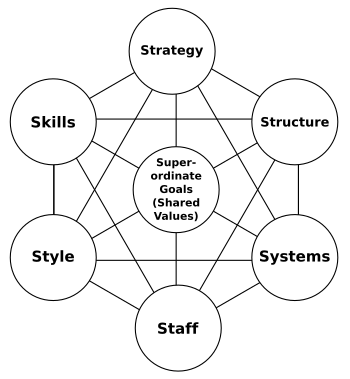
- Structure - Structure is the way in which a company is organized – chain of command and accountability relationships that form its organizational chart.
- Strategy - Strategy refers to a well-curated business plan that allows the company to formulate a plan of action to achieve a sustainable competitive advantage, reinforced by the company’s mission and values.
- Systems - Systems entail the business and technical infrastructure of the company that establishes workflows and the chain of decision-making.
- Skills - Skills form the capabilities and competencies of a company that enables its employees to achieve its objectives.
- Style - The attitude of senior employees in a company establishes a code of conduct through their ways of interactions and symbolic decision-making, which forms the management style of its leaders.
- Staff - Staff involves talent management and all human resources related to company decisions, such as training, recruiting, and rewards systems
- Shared Values - The mission, objectives, and values form the foundation of every organization and play an important role in aligning all key elements to maintain an effective organizational design.
The focus of the McKinsey 7s Model lies in the interconnectedness of the elements that are categorized by “Soft Ss” and “Hard Ss” – implying that a domino effect exists when changing one element in order to maintain an effective balance. Placing “Shared Values” as the “center” reflects the crucial nature of the impact of changes in founder values on all other elements.

The interdependency of this strategy development framework means that if one element changes, you will have to address the other six elements to analyze how the change affects them and to determine how each may need to change to keep organizational goals aligned.

Business uses of the McKinsey framework include:
- Determining how your business will achieve targets and goals
- Boosting productivity and performance
- Putting a proposed strategy into effect
- Facilitating the complexities of aligning departments and processes during mergers or acquisitions
- Examining the effects of organizational changes within the company
- Implementing policies to improve employee skills and competency
CULTURAL WEB
The Cultural Web is a tool used to map the culture of an organisation and is a way of seeing and understating the different influences that affect organisational. culture. It can be used to map existing culture and it can also used to map future. This, just like the 7S model above, could be applied to you personal life. Again it may seem incongruous or possibly manipulative to think of family, friends and fundamentals as something to be managed but it is all about relationships and behaviour whether that is in the business or home context.
- Stories and Myths
- What form of company reputation is communicated between customers and stakeholders?
- What stories do people tell new employees about the company?
- What do people know about the history of the organisation?
- What do these stories say about the culture of the business?
- Rituals and Routines
- What do employees expect when they arrive each day?
- What experience do customers expect from the organisation?
- What would be obvious if it were removed from routines?
- What do these rituals and routines say about organisational beliefs?
- Symbols
- What kind of image is associated with the company from the outside?
- How do employees and managers view the organisation?
- Are there any company-specific designs or jargon used?
- How does the organisation advertise itself?
- Control Systems
- Which processes are strongly and weakly controlled?
- In general, is the company loosely or tightly controlled?
- Are employees rewarded or punished for performance?
- What reports and processes are used to keep control of finance, etc?
- Organisation Structures
- How hierarchical is the organisation?
- Is responsibility and influence distributed in a formal or informal way?
- Where are the official lines of authority?
- Are there any unofficial lines of authority?
- Power Structures
- Who holds the power within the organisation?
- Who makes decisions on behalf of the company?
- What are the beliefs and culture of those as the top of the business?
- How is power used within the organisation?
LIFE WHEEL
In some aspects the Life Wheel combines much of what was in the 7S model and the Cultural Web and so it is logical to conclude our journey with this model. We have travelled from business mission and vision to personal fulfilment travelling through the some useful models that may help us understand the components and formulate strategies to improve the process and outcome for either, and ideally both.This tool was created by The Coaches Training Institute (CTI) in San Rafael, CA. I have found it to be a very useful tool for assessing where coaching may be of benefit to you. To complete the assessment, print this page and follow the directions. Rate each area of your life on the wheel from a 1 (not at all satisfied) to 10 (completely satisfied/could not be improved on) by drawing a line across the corresponding number in that section of the pie and then shading below it. When you are done, you will be left with a jagged wheel that should effectively illustrate areas for growth. This is where coaching starts. What happens next is up to you. Tim HJ Rogers MBA CITP PROJECTS, PROGRAMMES and CHANGE / CONSULTANT MENTOR COACH Adapt Consulting Company Consult CoCreate Deliver Mob +447797762051 Tim@AdaptConsultingCompany.com Tim Rogers is an experienced Project and Change Leader. He is founder of ciChange.org and curator for TEDxStHelier.Com . Roles have included Programme Manager for the incorporation of Ports and Jersey, and Jersey Post, as well as Operations Change and Sales Support for RBSI/NatWest. He is also Commonwealth Triathlete and World Championships Rower. He has a passion for learning and has been a Tutor/Mentor for the Chartered Management Institute. He is a Chartered Member of the British Computer Society, has an MBA (Management Consultancy) and is both a PRINCE2 and Change Management Practitioner. USEFUL LINKS An Introduction to Lean Canvas https://medium.com/@steve_mullen/an-introduction-to-lean-canvas-5c17c469d3e0 Change Models http://www.timhjrogers.com/blog/compendium%20change%20management%20models.html#A8 The Wheel of Life: a great personal assessment tool https://strategic-solutions-coaching.com/wheel-of-life/
Sunday, 24 January 2021
SOMETIMES YOU DONT KNOW WHAT YOU THINK UNTIL YOU WRITE IT DOWN
As a Coach and Mentor I often work with people to resolve whatever is holding them back. In one recent session the client described their life as entering a new chapter. The use of metaphors can be revealing and useful. We explored how the past, present and future chapters fitted together.

We then talked about the issues that were making it difficult to more from the past to the future, and played with the chapter metaphor a little. We started by narrowing down what might be on a page and expanding out what might be the whole book.

We agreed this approach was useful in putting the scale and pace of change into context. Is this a new chapter? Is it a whole new book? Or is it simply turning a page?

We agreed it would be a great exercise to take three pages and briefly write notes on the past, present and future. The process translates thoughts and feelings into words which can more easily and objectively assessed, and also prepares the ground for future discussions. Conversations can be rehearsed in the script.

By chronicling the past and scripting the future my client was able to gain control over thoughts and feelings, and choose the direction of her story, becoming author for her life.

BRAIN WASHING AND NEW THINKING

Apparently a form of brain washing of american soldiers was to get them to copy out texts that denounced americanism and capitalism. Whereas simply reciting words had no effect on the prisoners, apparently the process of copying text caused then to think about what they were writing. Their internal dialogue [what they said to themselves when they were writing] managed to convince themselves of things that their captors could not.

Writing, which inevitably involves self-talk, is a powerful way of surfacing and examining deeper thoughts in a process which explores meaning and truth before committing it to paper. This process is so powerful in self examination and reflection that story telling or narrative coaching is often used when coaching or mentoring clients about assumptions, ambitions and motives.

NEITHER MEMORIES OR STORIES ARE FIXED

Memories are not fixed or frozen. Every time we recall something from the past we examine it in a new context, and indeed may edit or update the memory with new meaning or purpose based on reflection or new data.  Memory therefore can be unreliable since each memory is a store of thoughts and feelings at one particular time, which might be potentially changed each time they are recalled.

For example, If you recite the story of that special day when you did that remarkable thing (remember that, that was huge!). Well the story will change over time. Maybe you add details or don't mention bits if telling your parents or partner or the people at work. Maybe that thing which was huge when you were 5, actually seems quite small now that you are a 5'10" adult. Or maybe that really nice thing looks very different with hindsight, now that you now know about that other thing, which you didn't know then.

It is a good thing to re-examine the past, but best done at a time and a place that does not distort the recollection and update with negative thoughts and feelings. The formula below hints at the problem of inaccurate memory.

Formula: Event + Data + Truth +  Experience = Reality

Problems:
1) Event is vague: It may be what is, isn't or might or didn't happen (but you wanted it to)?
2) Data is uncertain: Did we get all the sights, sounds and signals?
3) Truth is variable: [1] what is, [2] what is perceived [3] what we noticed
4) Experience is subjective: thought & emotion can change because of circumstance and context

A good coach will help you identify, surface, recognise and navigate these elements.

GOALS ARE SHORT STORIES IN THE BOOK OF YOUR LIFE

Having a goal gives people something to strive for, a purpose. Typically this might be family, but not necessarily mother and father type family. It could be colleagues, club, community or country. But it could be artistic, scientifice, literary purpose. Whatever you can conceive you can believe, and if you truly believe that may be your purpose.

This purpose, if it has personal value, will motivate and engage our exploratory and pursuit systems and support that effort with dopamine and analgesia to help us with the pursuit. It is a high, a drive, a passion of positive emotion. We often see this with high performance athletes who push beyond normality and pain.

We link memories together to form stories of our past. We may do a bit of editorial to make them coherent and flow: we do not like to think of life as random events so we use narrative to create logical consequence, because of this.. then that. We also like to think there is some fate to life: whether the locus of control is external [the world, God, work, politics sets my fate] or the locus of control is internal [I am the captain of my ship].

The result is that these short stories become your lifes work. As director or editor you get to chose the plot simply by deciding which scenes to keep and which to dump on the cutting room floor. If you create a story with purpose, a mission, or goal that transends the every-day (food, drink, sleep, consumption) then you can create and live with positive emotion, by taking responsibility as the screenwriter, director or editor for your life.


Tim HJ Rogers MBA CITP
PROJECTS, PROGRAMMES and CHANGE /  CONSULTANT MENTOR COACH
Adapt Consulting Company
Consult CoCreate Deliver
Mob +447797762051 Tim@AdaptConsultingCompany.com

Tim Rogers is an experienced Project and Change Leader and an ICF Trained Coach as well as mentor for the IoD. He is a past curator for TEDx. Roles have included Programme Manager for the incorporation of Ports and Jersey, and Jersey Post, as well as Operations Change and Sales Support for RBSI/NatWest. He is also Commonwealth Triathlete and World Championships Rower. He has a passion for learning and has been a Tutor/Mentor for the Chartered Management Institute. He is a former Chartered Member of the British Computer Society, has an MBA (Management Consultancy) and is both a PRINCE2 and Change Management Practitioner.


USEFUL LINKS

The True Story of Brainwashing and How It Shaped America
https://www.smithsonianmag.com/history/true-story-brainwashing-and-how-it-shaped-america-180963400/

Self Authoring Suite | Reviewing Jordan Peterson’s Self Authoring Program
https://andreian.com/self-authoring/